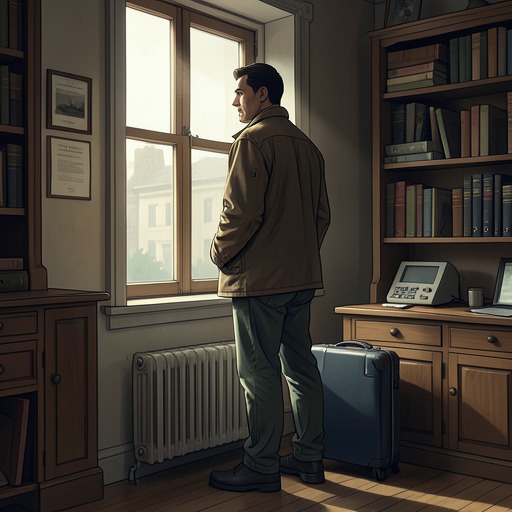
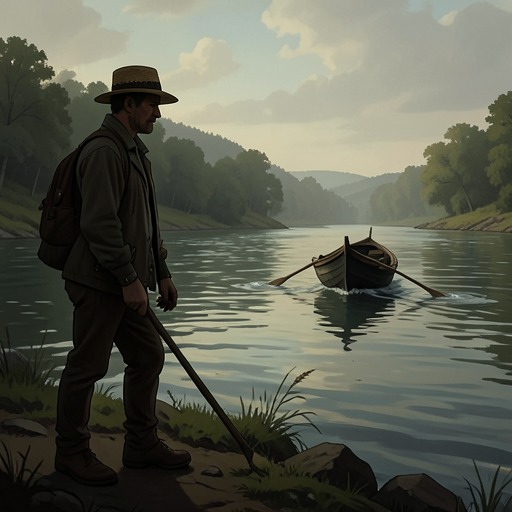
Trond Sander and his father
Out Stealing HorsesTrond Sander and his father are bound by a summer of travel, shared work, and close attention that becomes inseparable from the father’s disappearance from his life. Their relationship is remembered as tender and trusting, but its decisive ending remains unresolved: at fifteen, Trond Sander leaves for home believing his father will follow, then spends years wondering whether his father already knew he would not.
The 1948 summer journey
Two weeks into their stay, Trond Sander and his father travel from Oslo by train and continue from Elverum by bus. The journey takes most of the day. Trond Sander watches the farms, cows, and distant forest pass repeatedly through the window, while his father reads books about technical subjects, including house building and machines. From time to time the father raises his head, nods and smiles at his son, then returns to his reading. Their companionship does not depend on constant conversation: the boy sleeps and wakes, looks out at the landscape, and finds reassurance in the father’s steady presence beside him.
The bus finally stops beneath a large oak by a shop, at the last point it can reach. From there, father and son must walk. They take their bags and fishing gear towards the bridge, pause over the fast, foaming river, and stand together at the rail. Trond Sander trusts his father’s choice of where the journey ends and does not ask why they have come precisely there. In retrospect, the small scene establishes a defining quality of their bond: the boy accepts the father’s judgment, while the father carries him as far as he can.
A relationship learned through gesture and work
The father’s influence persists in Trond Sander’s adult practical life. When faced with a task beyond ordinary daily chores, Trond Sander closes his eyes and imagines how his father would have done it, or recalls watching him do it. He then imitates the remembered movements until the work falls into a rhythm and its sequence becomes clear. To Trond Sander, the method is not simply copying a technique. It is a way of discerning how a task is organized through the body: how to begin, how much force to use, and how one action leads into the next.
This private practice preserves the father as a working presence. The remembered man is barely forty, the age he was when Trond Sander last saw him at fifteen; in his son’s mind, he never grows older. The father’s practical competence therefore survives not as a general lesson but as a precise, physical template that Trond Sander can call up when he needs to act. The intimacy of the relationship continues in the son’s hands, even when the father is no longer there to demonstrate.
The father also appears as an adult who accepts responsibility. After an incident involving the two fathers, he stands with his back turned while lighting the stove and says that what happened was unnecessary, that he should have stopped it earlier, and that the fault was his. Trond Sander cannot be sure whether the father means that he and his son are grown men or that he and Jon’s father are; he guesses the latter. The exchange gives their closeness a more complicated dimension: the father does not merely protect or instruct his son, but speaks about his own responsibility, though the boy cannot fully determine the scope of what he is saying.
The farewell and its unresolved promise
At the end of the summer, Trond Sander leaves the village by bus for Oslo, with a change to the train at Elverum. His father stands behind him by the shop, one hand on his head, carefully explaining the journey as if the fifteen-year-old might not manage it alone. Trond Sander feels older than this treatment allows him to show. The father’s familiar care is comforting, but it also makes the departure feel like a separation between a child still being guided and a young person about to travel without him.
The father grips Trond Sander’s hair tightly enough for it almost to hurt, then lets go and reassures him that he will finish up in the village and come after him. Trond Sander answers that everything is all right, although an icy feeling in his stomach tells him it is not. He has heard the promise before. The bus carries him away past the shop, bridge, and oak tree; he presses against the window and watches until the bend hides his father. The scene takes on the shape of a rehearsed, fateful farewell, but its meaning is not immediately clear to the boy. Looking back, he cannot settle whether something beyond his father’s control happened or whether his father already knew he would never follow. It was the last time they saw each other.
Memory, inheritance, and absence
The unanswered departure remains active in Trond Sander’s adult life. When he reads the opening of David Copperfield, he recognizes in its question of who becomes the leading figure in one’s life a fear he has carried himself: the possibility of being displaced from the life that should have been his. He has not dared to ask Lars whether Lars took the place that belonged to him, or lived years that Trond Sander should have lived. The question draws his father’s absence into a wider uncertainty about lost time and the lives other people may have lived in his stead.
Trond Sander believes his father stayed by the river rather than fleeing to build a new life elsewhere. Yet Lars never speaks about the father, leaving Trond Sander to imagine that the silence may be an attempt to spare him, or may reflect a difficulty neither man can resolve. The father is thus present both through remembered competence and through what cannot be discussed. A memory can make him vivid, but it cannot answer the question raised by his promise at the bus stop.
In later life, after his wife and sister have both died within one month, Trond Sander loses interest in talking to other people and chooses to live near the forest. He says that the forest had once been central to his life, disappeared from it for a long time, and returned to his thoughts when the world around him fell silent. His retreat brings him back toward the landscape of his youth and the companionship he shared with his father. In memory, he can still return to their ride through the forest, along the ridge and across the border into Sweden, and to the night they slept beneath an overhang beside a fire. He no longer experiences the past simply as a foreign country: concentrating, he can enter it and feel the ride in his body. That return does not undo the separation. It shows how the father’s lasting presence is made from remembered movement, inherited skill, and a farewell whose promise never received an answer.